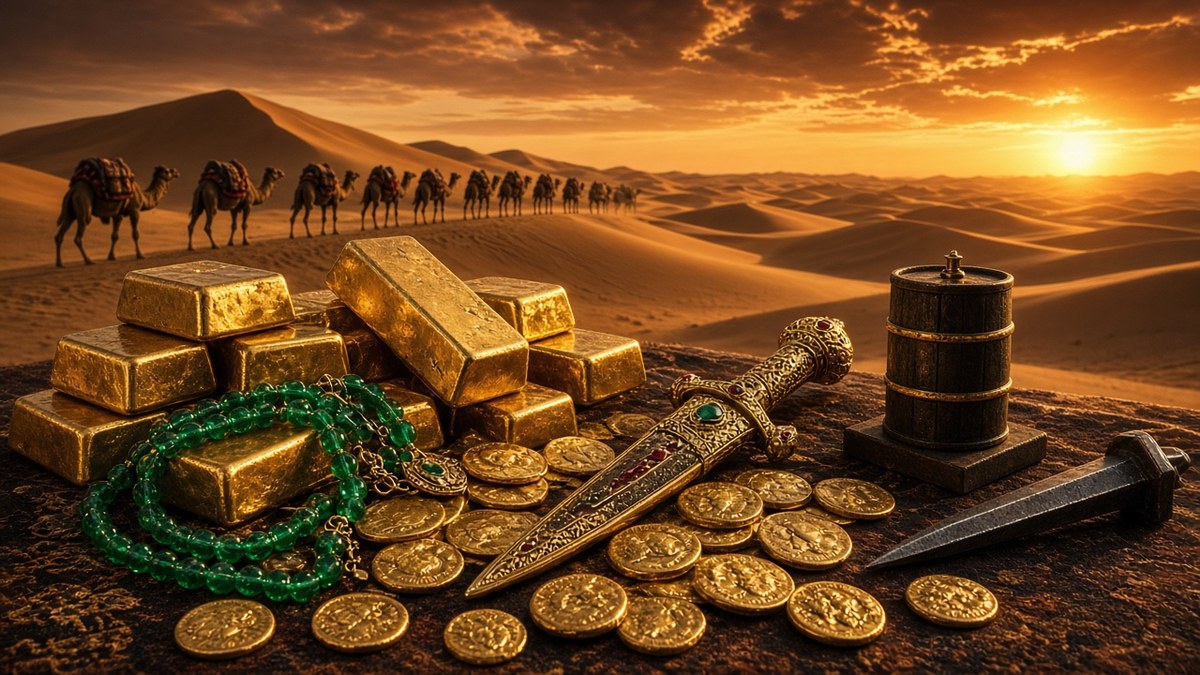
Today’s billionaires count their wealth in shares and stock options. The richest people in history counted theirs in gold dust, grain, railways and oil, and some of their fortunes were so vast that economists still argue over how to measure them. Billionaire Meter opens the vault on seven legendary fortunes, from a West African emperor to an American oil king.
1. Mansa Musa of Mali, 14th Century
When Mansa Musa, ruler of the Mali Empire, made his pilgrimage to Mecca in 1324, he travelled with a caravan reportedly carrying tons of gold. The Arab historian al-Umari wrote that he spent and gave so generously in Cairo that the value of gold there fell for years. Modern writers often call him the richest person who ever lived, though his wealth is impossible to price exactly.
2. Augustus Caesar, Rome
The first Roman emperor at one point held Egypt as a personal possession, and some modern estimates have put his personal fortune at a share of the entire Roman economy. Augustus used that power to rebuild Rome; he said he found a city of brick and left it a city of marble.
3. Jakob Fugger, Augsburg
Known as Jakob the Rich, the German banker financed emperors and popes from Augsburg. In 1519 his loans reportedly provided a large share of the money that helped Charles V win election as Holy Roman Emperor. He also founded the Fuggerei, a social housing estate still in use five centuries later.
4. Cornelius Vanderbilt, United States
The Commodore built a fortune in steamships, then railroads. When he died in 1877, his estate was reported at about $100 million, more than the United States Treasury held at the time according to many accounts.
5. Andrew Carnegie, Steel
In 1901, Andrew Carnegie sold Carnegie Steel to J.P. Morgan for $480 million, and Morgan reportedly congratulated him on becoming the richest man in the world. Carnegie then gave away most of his fortune, funding more than 2,500 public libraries.
6. Richest People in History, Modern Era: John D. Rockefeller
John D. Rockefeller’s Standard Oil once refined most of America’s oil. In 1916, newspapers reported that rising share prices had made him America’s first billionaire on paper. Measured as a share of the US economy, his fortune is still often ranked the largest in American history.
7. Mir Osman Ali Khan, Nizam of Hyderabad
In 1937, Time magazine put the Nizam of Hyderabad on its cover and called him the world’s richest man. His treasures reportedly included the 184 carat Jacob Diamond, which he is said to have used as a paperweight. The Jacob Diamond now belongs to the Government of India.
The Future Angle: The Fortunes of 2076
History’s great fortunes followed the age’s most valuable resource: gold, land, trade, steel and oil. The next may be built on AI compute, space mining or energy from fusion. See how today’s giants compare in how Jeff Bezos made his first billion and our richest women in the world in 2026, then tour the homes of wealth in the most expensive homes ever sold.
Visit the future: send us your idea
Who will be the richest person of 2076, and what will their fortune be made of? Send Billionaire Meter your prediction. Send us your idea.
FAQ
Who is considered the richest person in history?
Mansa Musa, the fourteenth century ruler of the Mali Empire, is often named the richest person who ever lived. During his 1324 pilgrimage to Mecca, he reportedly gave away so much gold in Cairo that its value there dropped for years. His wealth cannot be measured precisely in modern money.
Was John D. Rockefeller the first billionaire?
Rockefeller is widely described as America’s first billionaire. In 1916, newspapers reported that rising prices of Standard Oil shares had pushed his fortune past one billion dollars on paper. As a share of the American economy at the time, his wealth is still often ranked the largest in US history.
How much did Andrew Carnegie sell his company for?
Andrew Carnegie sold Carnegie Steel to J.P. Morgan in 1901 for $480 million, a deal that helped create U.S. Steel. Morgan reportedly congratulated him on becoming the richest man in the world. Carnegie spent the rest of his life giving his fortune away, including funding more than 2,500 libraries.
Keep reading
- 6 Historic Fortunes That Built the Future, From the Medici Bank to the Nobel Prize, in 2026
- 7 Legendary Luxury Houses With Centuries of History, From Breguet to Louis Vuitton, in 2026
- 10 Most Expensive Homes Owned by Billionaires in 2026
Sources named in text: al-Umari, Masalik al-Absar; Res Gestae Divi Augusti; Fugger archives, Augsburg; Contemporary US press reports (1877, 1901, 1916); Time magazine (1937).